← Herp Calendar map
Lizards
Giant Ameiva
Ameiva ameiva
Across the regions where it's common, the Giant Ameiva peaks from April to December.
Shows up in 1 ecoregion and 1 state
Keep Herp Calendar free
Hi, I'm Nick. I built Herp Calendar on my own and I keep it free, with no ads. If it has helped you find a herp this season, a small tip goes straight into the hosting and the data work. Only if you can spare it. Either way, I'm glad you're here.
Lizards
Giant Ameiva
Ameiva ameiva
Look, don't take. Many states regulate collecting reptiles and amphibians. Photograph it, log it on iNaturalist and leave it where you found it.
Description
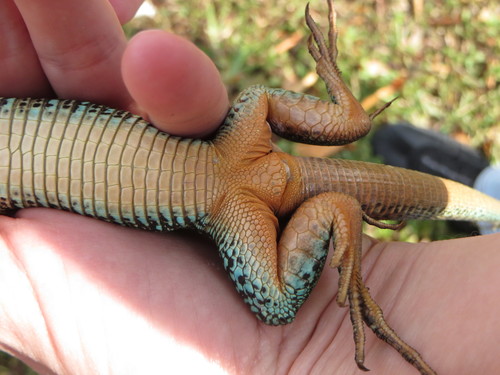
Ameiva ameiva, also known as the giant ameiva, green ameiva, South American ground lizard, or Amazon racerunner, is a species of lizard in the family Teiidae found in Central America, South America, and some Caribbean Islands. They grow to approximately 45–50 cm (18–20 in).Wikipedia ↗
Habitat
It is also found on the Caribbean islands of Trinidad and Tobago, Grenada, the Grenadines, Barbados, Dominica, St Kitts and Nevis, Margarita, Swan Island, and Isla de la Providencia. They live on the forest floor, often sheltering underneath logs and in leaf litter.Wikipedia ↗
When it's active
Its diet consists of mainly insects (such as grasshoppers, butterflies, cockroaches, mole crickets, beetles, termites, and insect larvae), frogs, other lizards (such as anoles, dwarf geckos, skinks, and even conspecifics), amphisbaenians, spiders, snails, and plant matter. The female lays several clutches of eggs from March to December.Wikipedia ↗
When and where it's active
Each row is its own calendar, counted from records in that area. Seasons shift by place.
PeakShoulderQuiet
Ecoregions
JanFebMarAprMayJunJulAugSepOctNovDec
South Florida introducedStates
JanFebMarAprMayJunJulAugSepOctNovDec
Florida introducedAbout the Giant Ameiva
When is the Giant Ameiva most active?
Across the regions where it's common, the Giant Ameiva peaks from April to December.
Where does the Giant Ameiva live?
It has enough records to show in 1 ecoregions and 1 states, including Florida.