Turtles
Florida Softshell Turtle
Apalone ferox
Across the regions where it's common, the Florida Softshell Turtle peaks from June to May.
Shows up in 2 ecoregions and 3 states
Keep Herp Calendar free
Hi, I'm Nick. I built Herp Calendar on my own and I keep it free, with no ads. If it has helped you find a herp this season, a small tip goes straight into the hosting and the data work. Only if you can spare it. Either way, I'm glad you're here.
Turtles
Florida Softshell Turtle
Apalone ferox
Description
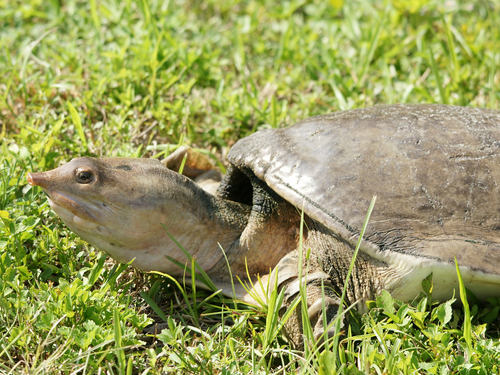
The Florida softshell turtle (Apalone ferox) is a species of turtle in the family Trionychidae. The Florida softshell turtle is a large turtle with a flattened, pancake-like body, a long neck, an elongated head with a long snorkel-like nose, and large webbed feet, each with three claws.Wikipedia ↗
Habitat
The Florida softshell turtle is found primarily in Florida, but it also ranges to southern sections of Alabama, Georgia, and South Carolina. It is the only species of softshell turtle whose range spans the entire Florida peninsula.Wikipedia ↗
When it's active
The Florida softshell turtle is almost entirely aquatic, emerging from the water only to bask or to lay eggs. Most (more than 90%) of mature females appear to breed every year.Wikipedia ↗Animal Diversity Web ↗
When and where it's active
Each row is its own calendar, counted from records in that area. Seasons shift by place.
Ecoregions
States
About the Florida Softshell Turtle
When is the Florida Softshell Turtle most active?
Across the regions where it's common, the Florida Softshell Turtle peaks from June to May.
Where does the Florida Softshell Turtle live?
It has enough records to show in 2 ecoregions and 3 states, including California, Florida, and Georgia.