Salamanders
Gregarious Slender Salamander
Batrachoseps gregarius
Across the regions where it's common, the Gregarious Slender Salamander peaks from January to April.
Shows up in 2 ecoregions and 1 state
Keep Herp Calendar free
Hi, I'm Nick. I built Herp Calendar on my own and I keep it free, with no ads. If it has helped you find a herp this season, a small tip goes straight into the hosting and the data work. Only if you can spare it. Either way, I'm glad you're here.
Salamanders
Gregarious Slender Salamander
Batrachoseps gregarius
Description
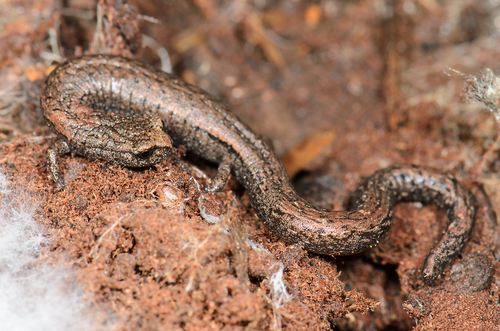
The gregarious slender salamander (Batrachoseps gregarius) is a species of salamander in the family Plethodontidae. The gregarious slender salamander is a small, slender species with a narrow head, short limbs, small hands and feet and a long tail that tapers near the tip.Wikipedia ↗
Habitat
The gregarious slender salamander is endemic to the western slopes of the southern and central Sierra Nevada in California, United States. It occurs at altitudes of up to 1,800 m (6,000 ft) but in the southern parts of its range seldom occurs above 900 m (3,000 ft).Wikipedia ↗
When it's active
The female deposits a clutch of eggs in a well-hidden location, under bark, under a fallen log or a rock, or in leaf-litter in a moist place, often near a seep or stream. Usually, the eggs are laid in communal nests.Wikipedia ↗
When and where it's active
Each row is its own calendar, counted from records in that area. Seasons shift by place.
Ecoregions
States
About the Gregarious Slender Salamander
When is the Gregarious Slender Salamander most active?
Across the regions where it's common, the Gregarious Slender Salamander peaks from January to April.
Where does the Gregarious Slender Salamander live?
It has enough records to show in 2 ecoregions and 1 states, including California.