← Herp Calendar map
Lizards
Veiled Chameleon
Chamaeleo calyptratus
Across the regions where it's common, the Veiled Chameleon peaks from July to January.
Shows up in 1 ecoregion and 1 state
Keep Herp Calendar free
Hi, I'm Nick. I built Herp Calendar on my own and I keep it free, with no ads. If it has helped you find a herp this season, a small tip goes straight into the hosting and the data work. Only if you can spare it. Either way, I'm glad you're here.
Lizards
Veiled Chameleon
Chamaeleo calyptratus
Look, don't take. Many states regulate collecting reptiles and amphibians. Photograph it, log it on iNaturalist and leave it where you found it.
Description
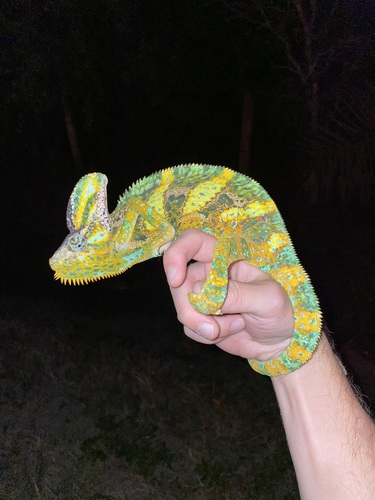
The veiled chameleon (Chamaeleo calyptratus) is a species of chameleon (family Chamaeleonidae) native to the Arabian Peninsula in Yemen and Saudi Arabia. The male is 43 to 61 cm (17 to 24 in) long from the snout to the tip of the tail.Wikipedia ↗
Habitat
It is native to the south-western Arabian Peninsula where the climate is semi-arid and tropical. Border between Yemen and Saudi Arabia: The veiled chameleon occupies high, dry plateaus and is found near the border of Yemen and Saudi Arabia along the foot of the escarpment and local wadis (inland river valley), to an elevation of almost 3,000 feet.Wikipedia ↗Animal Diversity Web ↗
When it's active
Veiled chameleons reach sexual maturity at four to five months and breed multiple times in a year. The female lays large clutches of up to 85 white, tough eggs and buries them in sand.Wikipedia ↗
When and where it's active
Each row is its own calendar, counted from records in that area. Seasons shift by place.
PeakShoulderQuiet
Ecoregions
JanFebMarAprMayJunJulAugSepOctNovDec
Southern Coastal Plain introducedStates
JanFebMarAprMayJunJulAugSepOctNovDec
Florida introducedAbout the Veiled Chameleon
When is the Veiled Chameleon most active?
Across the regions where it's common, the Veiled Chameleon peaks from July to January.
Where does the Veiled Chameleon live?
It has enough records to show in 1 ecoregions and 1 states, including Florida.