Snakes
Common Sharp-tailed Snake
Contia tenuis
Across the regions where it's common, the Common Sharp-tailed Snake peaks from February to April.
Shows up in 5 ecoregions and 2 states
Keep Herp Calendar free
Hi, I'm Nick. I built Herp Calendar on my own and I keep it free, with no ads. If it has helped you find a herp this season, a small tip goes straight into the hosting and the data work. Only if you can spare it. Either way, I'm glad you're here.
Snakes
Common Sharp-tailed Snake
Contia tenuis
Description
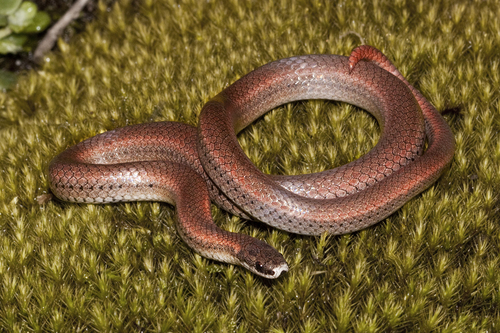
The sharp-tailed snake or sharptail snake (Contia tenuis) is a small species of nonvenomous snake in the family Colubridae. The sharp-tailed snake has an average total length (including tail) of 12–18 in (30–46 cm) as an adult.Wikipedia ↗
Habitat
C. tenuis is distributed through the states of California, Oregon, and Washington, as well as British Columbia, Canada: Southern Vancouver Island, British Columbia around Victoria, British Columbia, in Pemberton, British Columbia and newly discovered in 2026 on Lasqueti Island, British Columbia. The species is endemic to the Western United States and British Columbia.Wikipedia ↗
When it's active
The adult female C. tenuis lays 4–16 eggs in the summer, underground or in a burrow. Mating of the Sharp-tailed Snake occurs in spring and in the summer it lays 3-8 eggs.Wikipedia ↗Animal Diversity Web ↗
When and where it's active
Each row is its own calendar, counted from records in that area. Seasons shift by place.
Ecoregions
States
About the Common Sharp-tailed Snake
When is the Common Sharp-tailed Snake most active?
Across the regions where it's common, the Common Sharp-tailed Snake peaks from February to April.
Where does the Common Sharp-tailed Snake live?
It has enough records to show in 5 ecoregions and 2 states, including California and Oregon.