Lizards
Greater Earless Lizard
Cophosaurus texanus
Across the regions where it's common, the Greater Earless Lizard peaks from March to September.
Shows up in 6 ecoregions and 3 states
Keep Herp Calendar free
Hi, I'm Nick. I built Herp Calendar on my own and I keep it free, with no ads. If it has helped you find a herp this season, a small tip goes straight into the hosting and the data work. Only if you can spare it. Either way, I'm glad you're here.
Lizards
Greater Earless Lizard
Cophosaurus texanus
Description
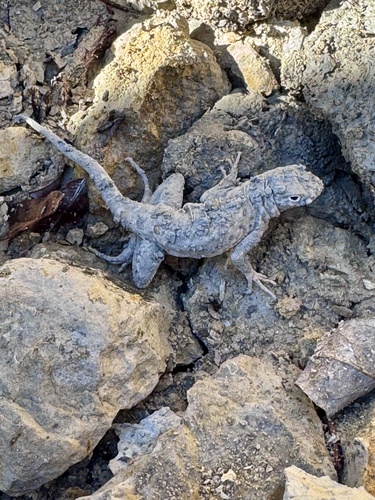
The greater earless lizard (Cophosaurus texanus) is the only species in the monotypic genus Cophosaurus. The greater earless lizard is a medium-sized lizard (relative to other species in its range) and the largest of the earless lizards.Wikipedia ↗
Habitat
The greater earless lizard occurs in the southwestern United States (Arizona, New Mexico, and Texas) and northern Mexico (Chihuahua, Coahuila, Durango, Nuevo León, San Luis Potosí, Sonora, Tamaulipas, and Zacatecas). The Texas greater earless lizard (C. t. texanus) occurs on the Edwards Plateau of Central Texas and northward to the state border with Oklahoma and southeastern areas of the Texas panhandle.Wikipedia ↗
When it's active
Mating occurs from April to August, peaking between late April and early July. Multiple clutches, up to four a year, are scattered over a wide area, with clutch size ranging from 2 to 9 eggs (average 3-5); more mature females produce larger clutches than younger females.Wikipedia ↗
When and where it's active
Each row is its own calendar, counted from records in that area. Seasons shift by place.
Ecoregions
States
About the Greater Earless Lizard
When is the Greater Earless Lizard most active?
Across the regions where it's common, the Greater Earless Lizard peaks from March to September.
Where does the Greater Earless Lizard live?
It has enough records to show in 6 ecoregions and 3 states, including Arizona, New Mexico, and Texas.