Lizards
Black Spiny-tailed Iguana
Ctenosaura similis
Across the regions where it's common, the Black Spiny-tailed Iguana peaks from February to January.
Shows up in 2 ecoregions and 1 state
Keep Herp Calendar free
Hi, I'm Nick. I built Herp Calendar on my own and I keep it free, with no ads. If it has helped you find a herp this season, a small tip goes straight into the hosting and the data work. Only if you can spare it. Either way, I'm glad you're here.
Lizards
Black Spiny-tailed Iguana
Ctenosaura similis
Description
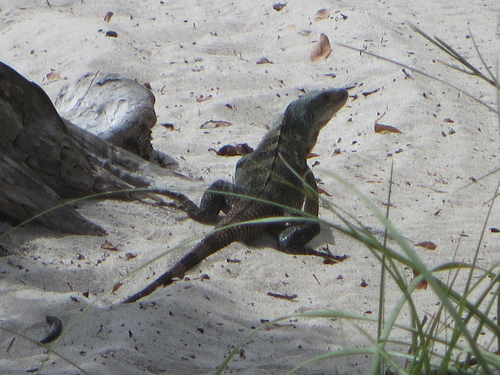
Ctenosaura similis, commonly known as the black iguana or black spiny-tailed iguana, is an iguanid lizard native to Mexico and Central America. The males are capable of growing up to 1.3 meters (4 ft 3 in) in length and the females are slightly shorter, at 0.8–1 meter (2 ft 7 in – 3 ft 3 in).Wikipedia ↗
Habitat
The black spiny-tailed iguana is native to southern Mexico and Central America, ranging from the Isthmus of Tehuantepec southward to Panama, occurring at sea level to ca. 1,320 meters elevation, but it is absent from interior highlands. They generally live in dry, arid, open terrain.Wikipedia ↗Animal Diversity Web ↗
When it's active
Mating generally occurs in the beginning of the dry season. The female, when receptive, will allow mating with a large male.Wikipedia ↗
When and where it's active
Each row is its own calendar, counted from records in that area. Seasons shift by place.
Ecoregions
States
About the Black Spiny-tailed Iguana
When is the Black Spiny-tailed Iguana most active?
Across the regions where it's common, the Black Spiny-tailed Iguana peaks from February to January.
Where does the Black Spiny-tailed Iguana live?
It has enough records to show in 2 ecoregions and 1 states, including Florida.