Salamanders
Long-tailed Salamander
Eurycea longicauda
Across the regions where it's common, the Long-tailed Salamander peaks from April to October.
Shows up in 6 ecoregions and 11 states
Keep Herp Calendar free
Hi, I'm Nick. I built Herp Calendar on my own and I keep it free, with no ads. If it has helped you find a herp this season, a small tip goes straight into the hosting and the data work. Only if you can spare it. Either way, I'm glad you're here.
Salamanders
Long-tailed Salamander
Eurycea longicauda
Description
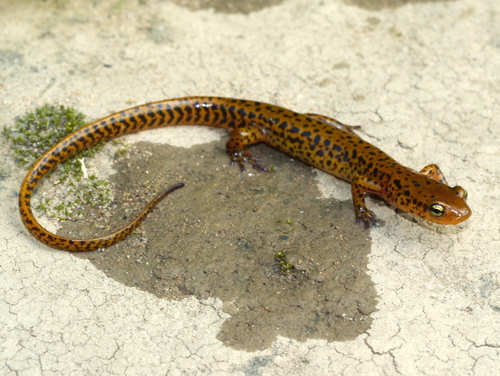
Eurycea longicauda, commonly known as the long-tailed salamander or longtail salamander, is a species of lungless salamander native to the Appalachian Region and Ohio River valley of the eastern United States. Body color varies from yellow to orange-red to red with random black spots.Wikipedia ↗
Habitat
Eurycea longicauda inhabit streamsides, spring runs, ponds, cave mouths, and abandoned mines. It is a "cave salamander" that frequents twilight zones of caves and also inhabits springs and surrounding forest.Wikipedia ↗
When it's active
The larvae hatch in January–March at about 10 mm (0.39 in) snout–vent length (SVL). The mating system of E. longicauda has not been studied extensively and remains largely unknown.Wikipedia ↗Animal Diversity Web ↗
When and where it's active
Each row is its own calendar, counted from records in that area. Seasons shift by place.
Ecoregions
States
About the Long-tailed Salamander
When is the Long-tailed Salamander most active?
Across the regions where it's common, the Long-tailed Salamander peaks from April to October.
Where does the Long-tailed Salamander live?
It has enough records to show in 6 ecoregions and 11 states, including Alabama, Illinois, Indiana, and Kentucky.