Snakes
Western Ribbon Snake
Thamnophis proximus
Across the regions where it's common, the Western Ribbon Snake peaks from February to July.
Shows up in 11 ecoregions and 7 states
Keep Herp Calendar free
Hi, I'm Nick. I built Herp Calendar on my own and I keep it free, with no ads. If it has helped you find a herp this season, a small tip goes straight into the hosting and the data work. Only if you can spare it. Either way, I'm glad you're here.
Snakes
Western Ribbon Snake
Thamnophis proximus
Description
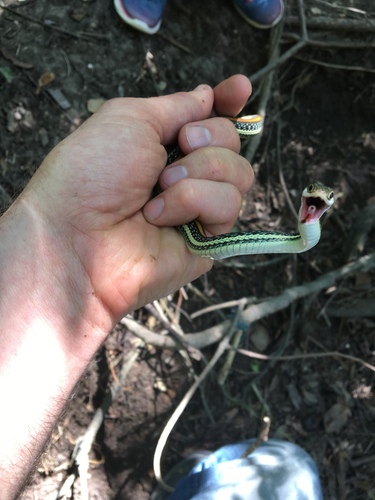
Thamnophis proximus, commonly known as the western ribbon snake or western ribbonsnake, is a species of garter snake in the subfamily Natricinae of the family Colubridae. T. proximus is a slender snake with a very long tail, approximately one-third of the total length of the body.Wikipedia ↗
Habitat
T. proximus is a semiaquatic snake that occurs in a wide range of habitats, usually not far from water. It feeds on a range of invertebrates (earthworms, crayfish) and small vertebrates (lizards, fishes, and frogs, including tadpoles).Wikipedia ↗
When it's active
Thamnophis proximus is most reproductively active during the spring, but the exact season in which breeding occurs is unknown.Animal Diversity Web ↗
When and where it's active
Each row is its own calendar, counted from records in that area. Seasons shift by place.
Ecoregions
States
About the Western Ribbon Snake
When is the Western Ribbon Snake most active?
Across the regions where it's common, the Western Ribbon Snake peaks from February to July.
Where does the Western Ribbon Snake live?
It has enough records to show in 11 ecoregions and 7 states, including Arkansas, Illinois, Kansas, and Louisiana.