Frogs and Toads
Southern Toad
Anaxyrus terrestris
Across the regions where it's common, the Southern Toad peaks from February to November.
Shows up in 6 ecoregions and 7 states
Keep Herp Calendar free
Hi, I'm Nick. I built Herp Calendar on my own and I keep it free, with no ads. If it has helped you find a herp this season, a small tip goes straight into the hosting and the data work. Only if you can spare it. Either way, I'm glad you're here.
Frogs and Toads
Southern Toad
Anaxyrus terrestris
Description
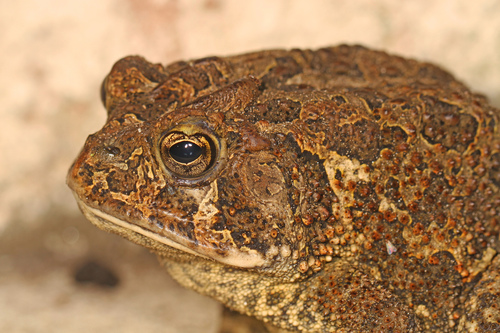
The southern toad (Anaxyrus terrestris) is a true toad native to the southeastern United States, from eastern Louisiana and southeastern Virginia south to Florida, where it is the largest toad found in that range. The southern toad is a medium-sized, plump species with a snout-to-vent length of up to 92 mm (3.6 in) with females being slightly larger than males.Wikipedia ↗
Habitat
The southern toad is found on the coastal plain of the southeastern United States. Its range extends from southern Virginia to Florida and Louisiana and there are two isolated populations on the Piedmont plateau and the Blue Ridge Mountains in South Carolina.Wikipedia ↗
When it's active
The southern toad is nocturnal and lives in a burrow by day, or sometimes hides under a log or pile of debris. It occurs in woodland in cultivated land and gardens and sometimes stands beneath outdoor lights at night to pick up the attracted insects that fall to the ground.Wikipedia ↗
When and where it's active
Each row is its own calendar, counted from records in that area. Seasons shift by place.
Ecoregions
States
About the Southern Toad
When is the Southern Toad most active?
Across the regions where it's common, the Southern Toad peaks from February to November.
Where does the Southern Toad live?
It has enough records to show in 6 ecoregions and 7 states, including Alabama, Florida, Georgia, and Mississippi.