Snakes
Western Rattlesnake
Crotalus oreganus
Across the regions where it's common, the Western Rattlesnake peaks from April to September.
Shows up in 16 ecoregions and 7 states · venomous
Keep Herp Calendar free
Hi, I'm Nick. I built Herp Calendar on my own and I keep it free, with no ads. If it has helped you find a herp this season, a small tip goes straight into the hosting and the data work. Only if you can spare it. Either way, I'm glad you're here.
Snakes
Western Rattlesnake
Crotalus oreganus
Description
Crotalus oreganus, commonly known as the Western rattlesnake or northern Pacific rattlesnake, is a venomous pit viper species found in western North America from the Baja California Peninsula to the southern interior of British Columbia. Mainland specimens often reach 100 cm (39 in) in length, with the largest on record being 162.6 cm (64.0 in) (Klauber, 1956) for C. o. oreganus.Wikipedia ↗
Habitat
It is found in North America from southwestern Canada, through much of the western half of the United States, to the Baja California Peninsula of Mexico. Specifically, the species migrates to find winter denning sites and foraging grounds for the summer In regards to the "hibernacula" that C. oreganus search for in the winter, studies show that the snakes may search for specific characteristics such as slope length and rock coverage.Wikipedia ↗
When it's active
Crotalus oreganus typically mate in the spring after emerging from winter dormancy, although British Columbia populations have been reported to mate in the fall before dormancy. Mating usually takes place in concealed areas, like burrows, crevices of rocks and logs, or dense brush.Wikipedia ↗
Venom
The C. oreganus venom possesses "hemotoxic" and "neurotoxic" properties leading to cardiovascular, internal bleeding, and headaches. The “venom composition” of C. oreganus' venom changes "ontogenetically" with smaller snakes having more toxic venom.Wikipedia ↗
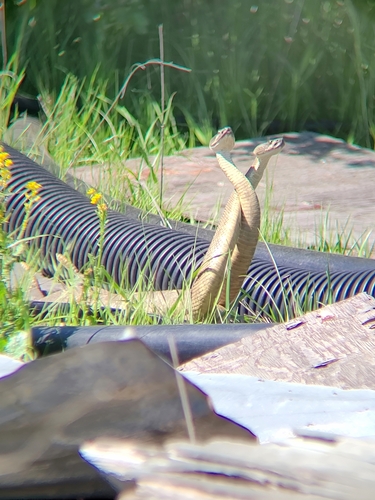
Harmless look-alikes
When and where it's active
Each row is its own calendar, counted from records in that area. Seasons shift by place.
Ecoregions
States
About the Western Rattlesnake
When is the Western Rattlesnake most active?
Across the regions where it's common, the Western Rattlesnake peaks from April to September.
Where does the Western Rattlesnake live?
It has enough records to show in 16 ecoregions and 7 states, including Arizona, California, Idaho, and Nevada.
Is the Western Rattlesnake venomous?
Yes. The Western Rattlesnake is venomous. Don't handle it, and give it room.
What snakes get mistaken for the Western Rattlesnake?
Harmless lookalikes include the Gopher Snake, Pine Snake, and Eastern Hognose Snake.