Snakes
Eastern Black-tailed Rattlesnake
Crotalus ornatus
Across the regions where it's common, the Eastern Black-tailed Rattlesnake peaks from June to October.
Shows up in 3 ecoregions and 2 states · venomous
Keep Herp Calendar free
Hi, I'm Nick. I built Herp Calendar on my own and I keep it free, with no ads. If it has helped you find a herp this season, a small tip goes straight into the hosting and the data work. Only if you can spare it. Either way, I'm glad you're here.
Snakes
Eastern Black-tailed Rattlesnake
Crotalus ornatus
Description
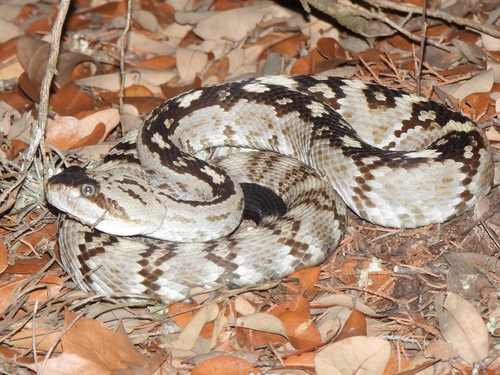
The black-tailed rattlesnake (Crotalus molossus) is a venomous pit viper species found in the southwestern United States and Mexico. Large specimens are usually not much more than 100 cm (39 in) long, although lengths of 125.0 cm (49.2 in) (Gloyd, 1940), 125.7 cm (49.5 in) (Klauber, 1972), and 129.5 cm (51.0 in) (Shaw & Campbell, 1974) have been reported.Wikipedia ↗
Habitat
The black-tailed rattlesnake is found in the southwestern United States in Arizona, New Mexico and west and central Texas, and Mexico as far south as Oaxaca, as well as the Gulf of California on San Estéban and Tiburón Islands. Its distribution reaches a maximum elevation of 2930 m, although it has been recorded at as high as 6900 feet at the McDonald Observatory in the Davis Mountains of west Texas.Wikipedia ↗
When it's active
Breeding occurs in the spring when males follow the pheromone trails of the females. The female gives birth to live young in the summer, and the babies stay with the mother only until they wander off on their own, usually in less than a day or two.Wikipedia ↗
Venom
The venom of the C. molossus is primarily hemotoxic, like that of most crotalids.Wikipedia ↗
Harmless look-alikes
When and where it's active
Each row is its own calendar, counted from records in that area. Seasons shift by place.
Ecoregions
States
About the Eastern Black-tailed Rattlesnake
When is the Eastern Black-tailed Rattlesnake most active?
Across the regions where it's common, the Eastern Black-tailed Rattlesnake peaks from June to October.
Where does the Eastern Black-tailed Rattlesnake live?
It has enough records to show in 3 ecoregions and 2 states, including New Mexico and Texas.
Is the Eastern Black-tailed Rattlesnake venomous?
Yes. The Eastern Black-tailed Rattlesnake is venomous. Don't handle it, and give it room.
What snakes get mistaken for the Eastern Black-tailed Rattlesnake?
Harmless lookalikes include the Gopher Snake, Pine Snake, and Eastern Hognose Snake.