Snakes
Mojave Rattlesnake
Crotalus scutulatus
Across the regions where it's common, the Mojave Rattlesnake peaks from July to September.
Shows up in 3 ecoregions and 5 states · venomous
Keep Herp Calendar free
Hi, I'm Nick. I built Herp Calendar on my own and I keep it free, with no ads. If it has helped you find a herp this season, a small tip goes straight into the hosting and the data work. Only if you can spare it. Either way, I'm glad you're here.
Snakes
Mojave Rattlesnake
Crotalus scutulatus
Description
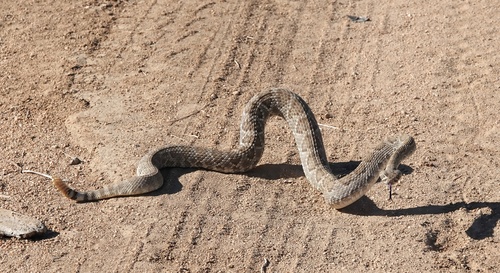
Crotalus scutulatus is species of rattlesnake, a venomous pit viper in the family Viperidae. Crotalus scutulatus grows to an average total length (tail included) of less than 100 cm (3.3 ft), with a maximum total length of 123.6 cm (4.1 ft) for males and 92.2 cm (3.0 ft) for females.Wikipedia ↗
Habitat
It also occurs as far north as Lincoln County in Nevada, the southwest corner of Washington County in Utah, and portions of extreme southern New Mexico. Campbell and Lamar (2004) supported the English name "Mohave (Mojave) rattlesnake" with some reluctance because so little of the snake's range lies within the Mojave Desert.Wikipedia ↗
When it's active
Crotalus scutulatus is most active from April to September. Courtship begins in late summer/fall, is interrupted by winter, and resumes in the spring.Wikipedia ↗
Venom
Neurotoxic C. scutulatus venom is used in the manufacture of CroFab®, while the venom of a tropical rattlesnake (C. simus) that expresses a very similar neurotoxin, is used in the production of Anavip®.Wikipedia ↗
Harmless look-alikes
When and where it's active
Each row is its own calendar, counted from records in that area. Seasons shift by place.
Ecoregions
States
About the Mojave Rattlesnake
When is the Mojave Rattlesnake most active?
Across the regions where it's common, the Mojave Rattlesnake peaks from July to September.
Where does the Mojave Rattlesnake live?
It has enough records to show in 3 ecoregions and 5 states, including Arizona, California, Nevada, and New Mexico.
Is the Mojave Rattlesnake venomous?
Yes. The Mojave Rattlesnake is venomous. Don't handle it, and give it room.
What snakes get mistaken for the Mojave Rattlesnake?
Harmless lookalikes include the Gopher Snake, Pine Snake, and Eastern Hognose Snake.