Salamanders
Eastern Newt
Notophthalmus viridescens
Across the regions where it's common, the Eastern Newt peaks from February to June.
Shows up in 19 ecoregions and 28 states
Keep Herp Calendar free
Hi, I'm Nick. I built Herp Calendar on my own and I keep it free, with no ads. If it has helped you find a herp this season, a small tip goes straight into the hosting and the data work. Only if you can spare it. Either way, I'm glad you're here.
Salamanders
Eastern Newt
Notophthalmus viridescens
Description
The eastern newt (Notophthalmus viridescens) is a common newt of eastern North America. The hatchlings range in length from 7 to 9mm and have fairly smooth skin with little toxicity.Wikipedia ↗Animal Diversity Web ↗
Habitat
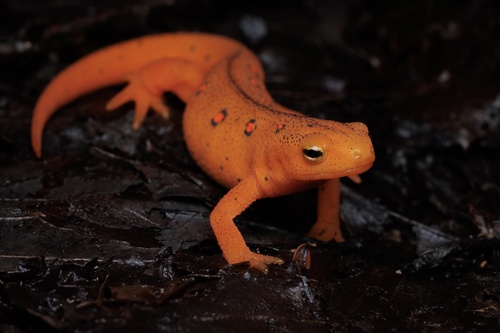
Habitat preferences include shallow water, quiet stretches of streams, swamps or ditches, lakes and ponds with heavy submerged vegetation. and nearby damp woodlands. Red efts may often be seen in a forest after a rainstorm.Wikipedia ↗
When it's active
Eastern newts have three stages of life: (1) the aquatic larva or tadpole, (2) the red eft or terrestrial juvenile stage, and (3) the aquatic adult. They also eat a lot of snails, beetles, ants, and mosquito larvae, with an annual ingestion of about 35,000 kcal.Wikipedia ↗
When and where it's active
Each row is its own calendar, counted from records in that area. Seasons shift by place.
Ecoregions
States
About the Eastern Newt
When is the Eastern Newt most active?
Across the regions where it's common, the Eastern Newt peaks from February to June.
Where does the Eastern Newt live?
It has enough records to show in 19 ecoregions and 28 states, including Alabama, Arkansas, Connecticut, and Florida.