Frogs and Toads
Cuban Tree Frog
Osteopilus septentrionalis
Across the regions where it's common, the Cuban Tree Frog peaks from June to November.
Shows up in 3 ecoregions and 1 state
Keep Herp Calendar free
Hi, I'm Nick. I built Herp Calendar on my own and I keep it free, with no ads. If it has helped you find a herp this season, a small tip goes straight into the hosting and the data work. Only if you can spare it. Either way, I'm glad you're here.
Frogs and Toads
Cuban Tree Frog
Osteopilus septentrionalis
Description
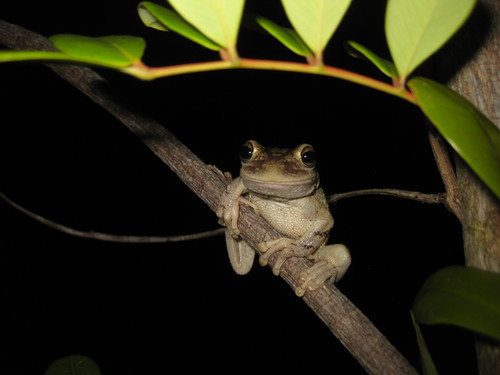
The Cuban tree frog (Osteopilus septentrionalis) is a large species of tree frog that is native to Cuba, the Bahamas, and the Cayman Islands; but has become invasive in several other places around the Americas. Cuban tree frogs are the largest tree frogs in North America, ranging from 2 to 5.5 inches or (5 to 12.7 cm) in length.Wikipedia ↗
Habitat
The Cuban tree frog is native to Cuba, the Bahamas, and the Cayman Islands. Whether the species was native to the Key West region of Florida is debated, or if it was introduced to the area.Wikipedia ↗
When it's active
Cuban tree frogs are mainly nocturnal and sleep during the day, preferring to hunt and breed when the sun goes down. During the breeding season, the male will have a black nuptial pad on his hand or wrist that helps him hold onto the female during amplexus.Wikipedia ↗
When and where it's active
Each row is its own calendar, counted from records in that area. Seasons shift by place.
Ecoregions
States
About the Cuban Tree Frog
When is the Cuban Tree Frog most active?
Across the regions where it's common, the Cuban Tree Frog peaks from June to November.
Where does the Cuban Tree Frog live?
It has enough records to show in 3 ecoregions and 1 states, including Florida.