Snakes
Central Ratsnake
Pantherophis alleghaniensis
Across the regions where it's common, the Central Ratsnake peaks from April to July.
Shows up in 13 ecoregions and 21 states
Keep Herp Calendar free
Hi, I'm Nick. I built Herp Calendar on my own and I keep it free, with no ads. If it has helped you find a herp this season, a small tip goes straight into the hosting and the data work. Only if you can spare it. Either way, I'm glad you're here.
Snakes
Central Ratsnake
Pantherophis alleghaniensis
Description
The central ratsnake (Pantherophis alleghaniensis), also commonly known as the black ratsnake, chicken snake, gray ratsnake, midland ratsnake, and pilot black snake, is a species of nonvenomous snake in the subfamily Colubrinae of the family Colubridae. A medium to large serpent, the gray ratsnake typically reaches an adult size of 99–183 cm (3.25–6.00 ft) total length (including tail); however, the record is 213.9 cm (7.02 ft).Wikipedia ↗
Habitat
Native to North America, Pantherophis alleghaniensis is commonly found in the forests of the eastern and central United States, west of the Appalachian Mountains and east of the Mississippi River. It occurs relatively continuously throughout the major part of the eastern half of the United States, along the Piedmont throughout Kentucky, from southwestern New England to the Gulf of Mexico, westward to the Mississippi River, and northward from northern Louisiana to southwestern Wisconsin.Wikipedia ↗
When it's active
The central ratsnake hunts using a combination of sit and wait, active pursuit, and nest predation strategies. Its active hunting style leads to a consistent high metabolic state and high average body temperature.Wikipedia ↗
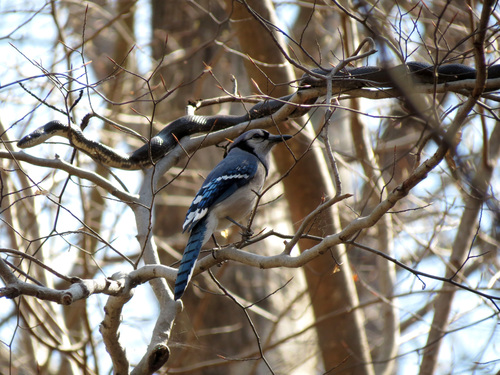
Often mistaken for
When and where it's active
Each row is its own calendar, counted from records in that area. Seasons shift by place.
Ecoregions
States
About the Central Ratsnake
When is the Central Ratsnake most active?
Across the regions where it's common, the Central Ratsnake peaks from April to July.
Where does the Central Ratsnake live?
It has enough records to show in 13 ecoregions and 21 states, including Alabama, Connecticut, Delaware, and Florida.
What does the Central Ratsnake look like?
It's often confused with the Eastern Copperhead and Broad-banded Copperhead.