Salamanders
Red Salamander
Pseudotriton ruber
Across the regions where it's common, the Red Salamander peaks from February to June.
Shows up in 9 ecoregions and 14 states
Keep Herp Calendar free
Hi, I'm Nick. I built Herp Calendar on my own and I keep it free, with no ads. If it has helped you find a herp this season, a small tip goes straight into the hosting and the data work. Only if you can spare it. Either way, I'm glad you're here.
Salamanders
Red Salamander
Pseudotriton ruber
Description
The red salamander (Pseudotriton ruber) is a species of salamander in the family Plethodontidae (lungless salamanders) endemic to the Eastern United States. The Pseudotriton ruber is a medium-large salamander, with adults ranging from 4.3 to 7.1 in (11–18 cm) in total length.Wikipedia ↗
Habitat
Red salamanders are also found in deciduous or mixed hardwood forests, especially near streams, seepages, and in leaf packets near spring-fed brooks. The Blue Ridge red salamander is found in elevations to more than 5,000 ft (1,500 m) in the southern part of the Blue Ridge Mountains of Virginia.Wikipedia ↗
When it's active
Larvae mainly feed on invertebrates such as insect larvae and worms. Larval diet specifically has been shown to consist of Chironomidae (36.52% of prey items) and Sphaeriidae (15.17%) as well as terrestrial prey (7.87%) and other salamanders.Wikipedia ↗
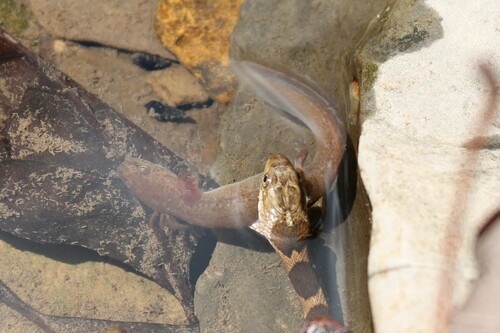
When and where it's active
Each row is its own calendar, counted from records in that area. Seasons shift by place.
Ecoregions
States
About the Red Salamander
When is the Red Salamander most active?
Across the regions where it's common, the Red Salamander peaks from February to June.
Where does the Red Salamander live?
It has enough records to show in 9 ecoregions and 14 states, including Alabama, Florida, Georgia, and Kentucky.